Most accessible
From the Vietnam bank
Open to every visitor
See this tourHelp with your choice
Two questions, one border
Say how much time you have and how you like to travel, and the tour that fits appears with its starting price.
Your ideal pick
from $63
Ten hours with the cave, the pagoda, the falls and Angel Eye mountain, in a group limited to 10.
Your ideal pick
from $132
A small group limited to 8 that meets at My Dinh Bus Station at 21:00 and rides the sleeper bus overnight.
Your ideal pick
from $190
Pickup in Hanoi, a homestay night and the falls on the second day, with a raft for a small surcharge.
Your ideal pick
from $182
Two days with a hotel night near the falls and a private group available.
Your ideal pick
from $82
A day of 10 hours in a small group limited to 10, ending at Angel Mountain at sunset.
How the same river forms a Vietnamese fall and a Chinese fall, why the published heights disagree, what the cross-border site offers and what visitors holding other passports can do instead.
Editorial team, bangiocwaterfall.top · Updated November 16, 2026 · Quick read: 7 min
The essentials
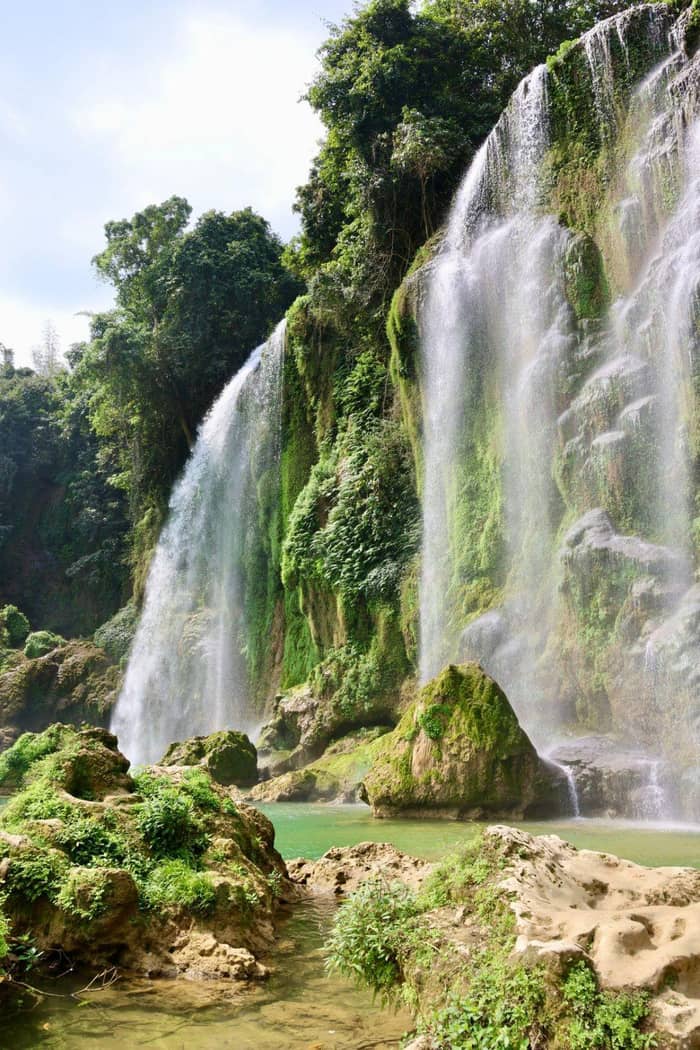
Ban Gioc waterfall on the Vietnam-China border has a Vietnamese name and a Chinese one, Ban Gioc and Detian, for the same waterfall system, and a visitor to either bank is looking at the other side's fall as well. The Quay Son river begins in China, crosses into Vietnam and arrives at the village of Ban Gioc in Dam Thuy commune, where it splits into several branches and spills down the ledges.1 On the Vietnamese side that village belongs to Cao Bang province, Trung Khanh district, and on the Chinese side the fall is in Guangxi.11,12
The state press calls the main part of the fall the border itself. Voice of Vietnam describes Ban Gioc as two parts, the main one standing at the heart of the Vietnam-China border with the Quay Son river marking its limit below.2 That is why you will meet the hyphenated name Ban Gioc-Detian in official texts: the cooperation model between the sides carries both names.13
For a traveller the difference is a view rather than a place. From the Vietnamese bank you see the wide face of the fall with rice fields beside it and limestone peaks behind, and the Chinese bank sees it from the other side, with a shopping street and some viewing venues close by.12 Both banks sit in the setting of the Non Nuoc Cao Bang UNESCO Global Geopark, recognised in 2018, which gives insight into more than 500 million years of the planet's history.14
Side by side
| Point | Ban Gioc (Vietnam) | Detian (China) |
|---|---|---|
| Province | Cao Bang, Trung Khanh district11 | Guangxi12 |
| Who may visit | Any visitor on the Vietnamese side10 | Chinese and Vietnamese nationals in the cross-border zone9 |
| Fee in the pilot | 45,000 VND for the falls and the cave10 | No fee for visitors from Vietnam20 |
| Nearby sights | Truc Lam pagoda and Nguom Ngao cave21,22 | A shopping street and viewing venues12 |
| Hours of the zone | 8 AM to 2 PM Hanoi time23 | 9 AM to 3 PM Beijing time23 |
The fee and rule figures are those of reports from 2023 and 2024; confirm the current ones before you travel.24,10
The numbers you find for the fall are not consistent, and the inconsistency is itself useful to know. Vietnam News Agency gave a height of 30 metres and a width of 300 metres, and added that it is the widest waterfall in the country though not the highest.4,19 VietNamNet in 2016 measured 35 metres high across 300m, and the same outlet in 2022 gave 53 metres high and 300 metres wide.5,6 In 2026 VietnamPlus described the Ban Gioc-Detian falls as rising over 60m and spanning hundreds of metres.7
Why the figures differ is not explained by any of them. The fall is a series of steps rather than a single drop, and a height can mean the top step, the total drop or the main curtain; a width can mean the Vietnamese part or the whole border system. A fair way to quote the fall is to name the source and say the width is about 300 metres in the older reports and hundreds of metres in the newest.4,5,6,7
The ranking is steadier. State media rank Ban Gioc as the fourth largest waterfall on an international border, behind Iguazu on the Brazil-Argentina line, Victoria on the Zambia-Zimbabwe line and Niagara on the Canada-America line.3 The wording is a ranking of border falls, which is a narrow category, so it is better read as a way of understanding the place than as a record to repeat on a sign.
The river does the political work in the story of Ban Gioc waterfall and the Quay Son river. Because the main fall is delimited by the Quay Son river flowing below it, the line that separates the countries runs through the water instead of along a fence.2 Visitors who ride the Vietnamese raft can walk to marker 836, a Vietnamese border post put up in 2001, once they land.25 The raft page of this site explains the ride and its fee in full.
The setting around the line is lived-in. Trung Khanh district is home to the Tay, Nung, Thai and Mong peoples, and the fall belongs to their landscape as much as to the border.28 Vietnam News Agency says the fall was officially recognised as a national scenic spot in 1997, long before the cross-border tours.15 That timeline is useful: Ban Gioc had a long life as a Vietnamese attraction before it became a shared tourism zone.
The geopark text adds the deeper background. Non Nuoc Cao Bang covers 3,000 square kilometres in the north of Vietnam and is home to nine ethnic groups.29,30 The fall is one of its most visited features, and the geopark is why it appears in official texts as part of a protected landscape rather than as an isolated view. For a visitor that means caves, villages and viewpoints within a short drive.
Ways to see the shared fall
Most accessible
Open to every visitor
See this tour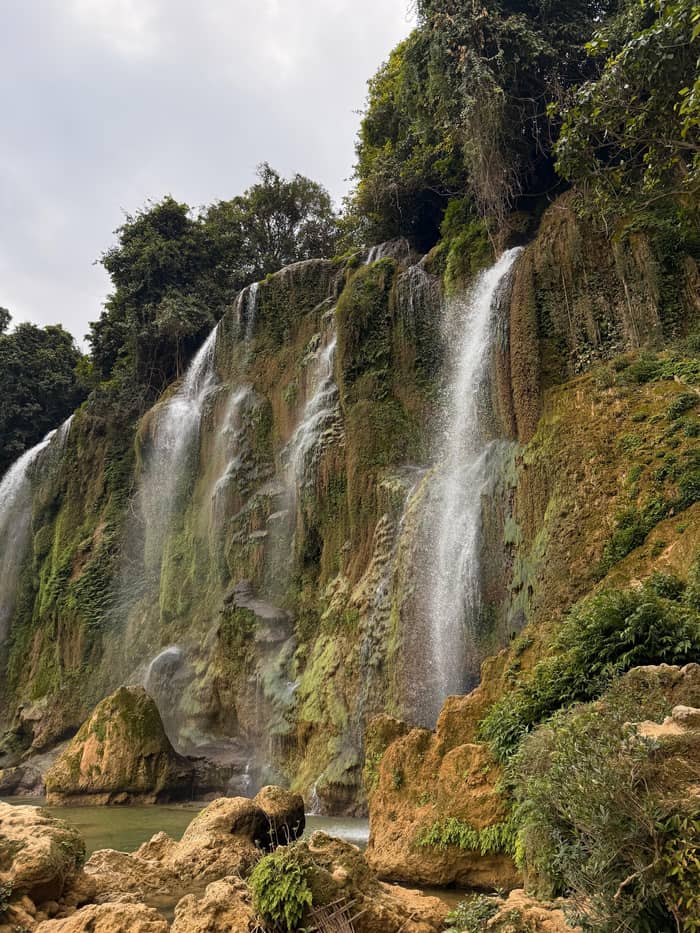
Both sides
For eligible nationals
See this tour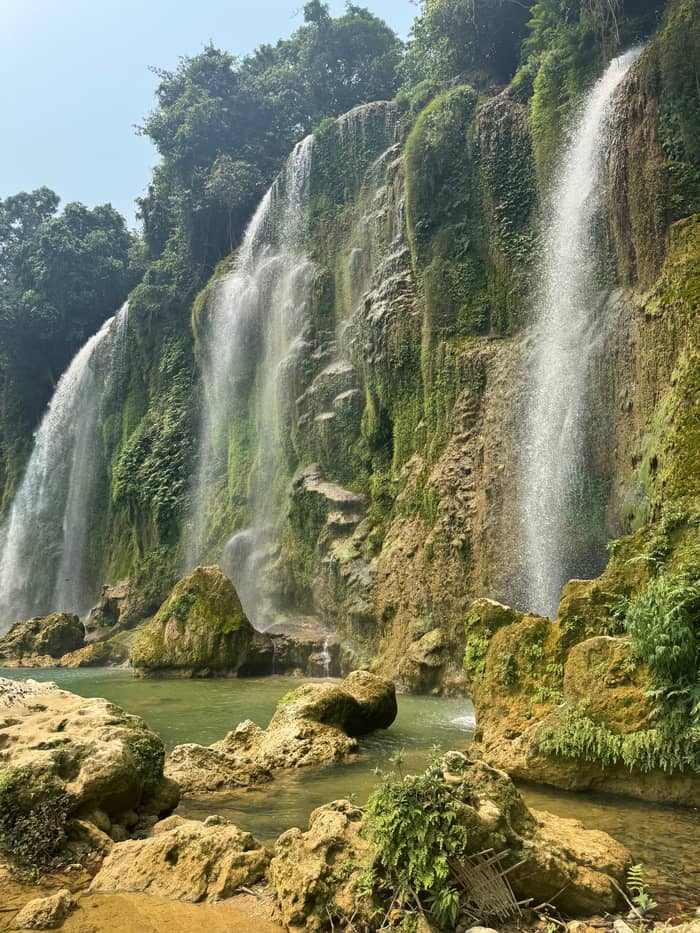
Shortest
A loop from the city
A formal way to see both sides exists, and it has a short history. Cao Bang launched tours of the Ban Gioc-Detian waterfall on the Vietnam-China border from September 15, 2023, and from the Vietnamese side a package cost VND790,000 per person.16,27 The pilot ran to September 15, 2024 and welcomed over 13,000 visitors, and the site was officially opened to tourists on October 15, 2024.24,8 Between those dates, tours were temporarily suspended after nearly 950 groups with around 12,000 visitors had crossed.17
The rules are tight. The scenic zone operates from 8 AM Hanoi time to 2 PM, which is 9 AM to 3 PM Beijing time, and tourist management limits each group to 20 people.23,26 Tuoi Tre reported a daily maximum of 1,000 visitors from both countries, in groups of 20 members or fewer.32 Visitors need their passports or entry and exit permits for the scenic areas on both sides.31
Eligibility is the point most readers need. At the opening VietnamPlus reported that the site admits only Chinese and Vietnamese nationals, and that visitors from either country may not spend the night on the other side.9 That means a visitor with another passport cannot rely on the cross-border tour, and should check the current rule before planning around it. Fees in the pilot differed by side: visitors from China paid 70,000 VND per person on the Vietnamese side, while visitors from Vietnam paid no fee on the Chinese side.33,20
Price the trip
Enter your party and compare tours that reach the Vietnamese bank.
Compare 4 side by side
Enter your party and compare tours that reach the Vietnamese bank.
≈
View≈
View≈
View≈
ViewStarting prices as on the booking platform, converted at the ECB reference rate. You see the exact price at booking.
A short history
Early years
Ban Gioc was officially recognised as a national scenic spot in 1997.15
The trial
Cao Bang launched Ban Gioc-Detian tours from September 15, 2023.16
The pause
Tours were temporarily suspended after nearly 950 groups had crossed.17
The opening
The site opened to tourists officially on October 15, 2024.8
Today
On April 13, 2026, 30 local artists sang folk duets on boats along the border river.18
On the Vietnamese side the day is built around the water, the pagoda and the cave. Tuoi Tre says visitors can tour Ban Gioc Waterfall and the Phat Tich Truc Lam Pagoda, roughly 500 meters from the cascade.21 Nguom Ngao cave lies close by and is open to visitors for 945.8 metres.22 The 2023 ticket for the waterfall and the cave together was 45,000 VND.10
On the Chinese side the visit is organised differently. Tuoi Tre lists Detian Waterfall in Guangxi Province, a shopping street close to it and a few places that overlook the cascade.12 Those who hold eligible passports cross in guided groups and return the same day, since overnight stays across the line are not permitted.9 The timetable also differs: groups must be through the zone by early afternoon.23
The visitor figures show how popular the arrangement became. After nearly a month of official operation the site welcomed close to 11,000 visitors, and the Guangxi tourism department reported that the number of cross-border tourists rose from 500 to 1,000 a day on each side.34,35 For a tourist from elsewhere these numbers say little, since the quota is reserved for Chinese and Vietnamese visitors, but they show how quickly the cross-border arrangement grew.
Video
Rich Ellison on YouTube · Tap play to load the video; not before.
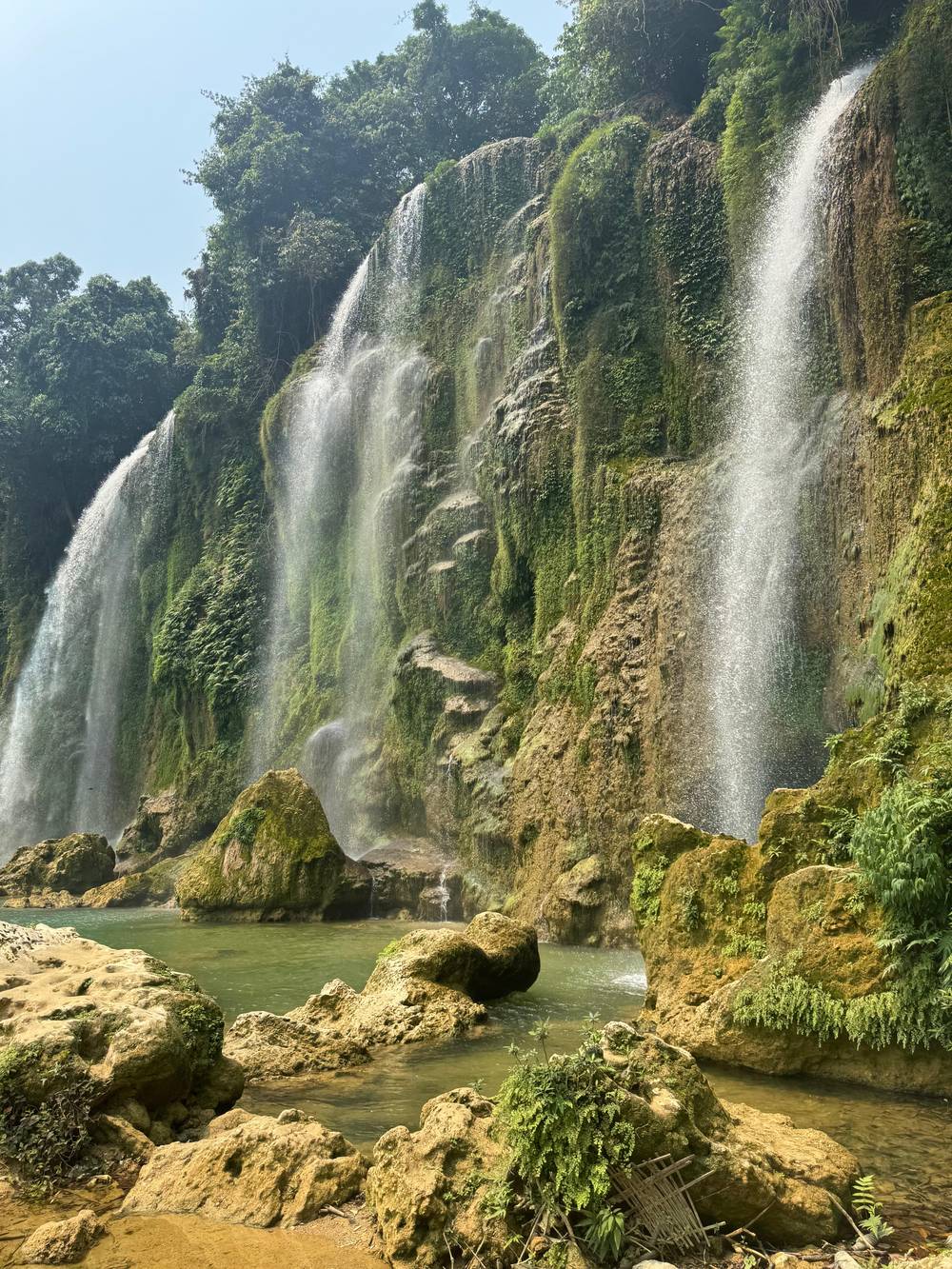
Ban Gioc waterfall is the world’s fourth largest border waterfall, after Iguazu Falls on the Brazil-Argentina border, Victoria Falls on the Zambia-Zimbabwe border, and Niagara Falls on the Canada-America border.
Before you go
For most readers of this site the answer is simple: see the falls from Vietnam. The cross-border zone is limited to Chinese and Vietnamese nationals, so travellers with other passports spend their time at the Vietnamese viewing areas, the raft, the pagoda and Nguom Ngao cave.9 Our own 2-day tour from Hanoi is built that way, with a night in a local homestay and the falls on the second day, from $189.
If your time is short and you start in Cao Bang city, a day tour fits the cave, the temple, the cascade and the mountain with the hole into 10 hours from $62. A longer small-group 2-day option starts from $181. Whichever you pick, read the current rules from the province before any border-side plan, because the arrangement moved from a pilot in 2023 to a permanent site in 2024.16,8
Treat Detian as a second, optional chapter rather than the reason to go. The Vietnamese bank already gives you the full width of the fall, the sound and the spray, and the mix of ethnic culture, cave and limestone farmland that no cross-border permit can add. If you are eligible, ask your operator whether the crossing is open on the date you travel, since tours were suspended once already.17
FAQ
VietnamPlus reported that the site admits only Chinese and Vietnamese nationals.9
It runs from 8 AM Hanoi time to 2 PM, which is 9 AM to 3 PM in Beijing.23
Tourist management limits each visiting group to 20 people at a time.26
Vietnam News Agency calls it the widest in the country, though not the highest.19
Sources
Planning the road to Ban Gioc from Hanoi? Ask a real person here.