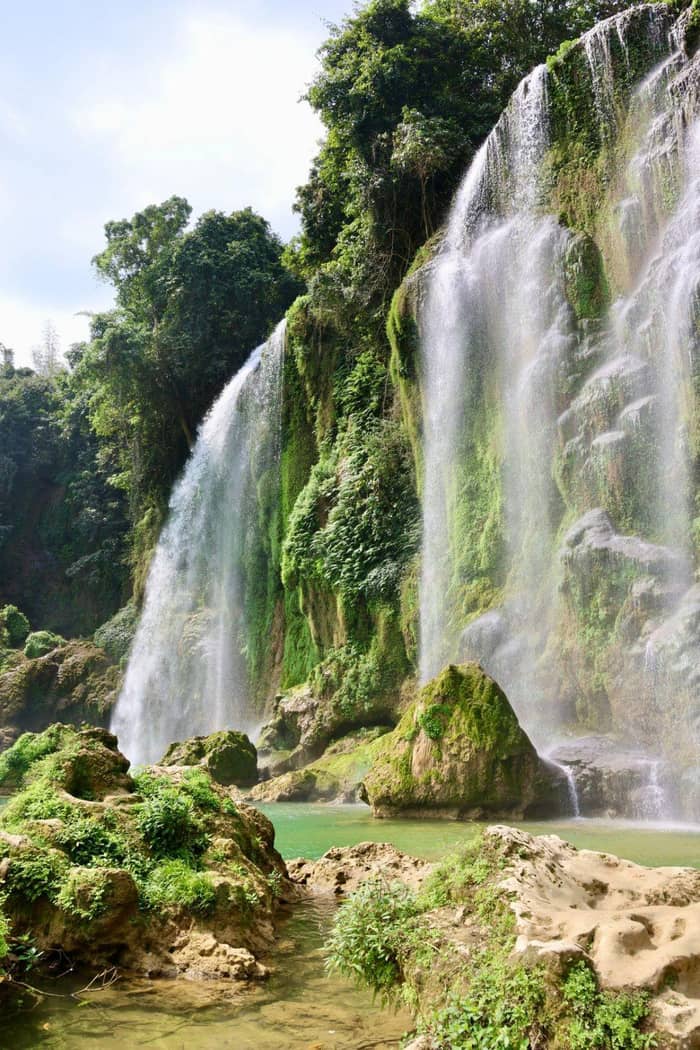
Fullest river
The rainy summer
May to August
See the 2-day tourHelp with your choice
Two questions, one date
Say when you can travel and what matters to you, and the tour that fits appears with its starting price.
Your ideal pick
from $190
Two days from Hanoi: about 6 hours to Cao Bang city, a homestay night, then the cave, the temple and the falls.
Your ideal pick
from $63
A day of 10 hours with a small group limited to 10, a cave visit of about 40 min and the falls at 13:00.
Your ideal pick
from $182
Two days with a hotel near the falls, a boat near the waterfall that you pay for yourself and a private group available.
Where the state press sees the falls at their fullest, what the weather record adds for each month, how the festival week changes the visit and when the caves and viewpoints are easiest.
Editorial team, bangiocwaterfall.top · Updated November 16, 2026 · Quick read: 7 min
The essentials
The best time to visit Ban Gioc waterfall depends on what you hope to see in the water, and the official voices give slightly different windows. Vietnam News Agency says the falls look most beautiful between June and October, and singles out September and October, when the river is full.1 A report from the broadcaster VOV says the site is at its most impressive in the rainy season, between May and September.2 Another report, in Tuoi Tre, puts the best period at September to December.3
Lay these windows over each other and September is the only month that all of them include. That makes September, with October beside it, the safest answer for a first visit that is built around the water. The edges are real choices rather than mistakes: a visitor who values clear skies over thunder can lean towards October or November, while one who wants the river at its loudest can lean towards the middle of the summer.
None of the sources promises a perfect day. Mountain weather in the far north-east changes quickly, and a booking that is free to cancel until 24 hours before departure lets you move a trip when a forecast turns bad. Treat the sections below as a month-by-month map: the climate record tells you what the sky usually does, and the state press tells you what the river and the programme do in each season.
Month by month
| Month | Daily high and low | Rain | What the sources add |
|---|---|---|---|
| January | 18.4 °C and 11.3 °C5 | 31 mm5 | Water recedes in winter4 |
| April | 28.3 °C and 20.4 °C5 | 72 mm5 | Warming, with the dry cave season ending10 |
| June | 33.2 °C and 24.9 °C5 | 245 mm5 | Inside the wet-season window2 |
| July | 33.6 °C and 25.1 °C5 | 235 mm5 | Summer peak season for visitors11 |
| September | 32.3 °C and 23.2 °C5 | 133 mm5 | Full of water, says the agency1 |
| October | 29.6 °C and 20.2 °C5 | 65 mm5 | Festival week and a cave that is easier to walk6,10 |
| November | 25.7 °C and 15.8 °C5 | 36 mm5 | Inside the September to December window3 |
| December | 21.1 °C and 12.1 °C5 | 24 mm5 | Cool mornings, so bring a layer4 |
Warmth readings are from Longzhou in China and rainfall readings from Cao Bang; neither station holds both, so they are placed side by side.5
Ban Gioc is fed by the Quay Son river, which rises in China and reaches the village of Ban Gioc, where the water splits into branches before it tumbles over the ledges.8 More rain upstream means more water over the lip, which is why the state press ties the best views to the wet months. The record behind the chart on this page takes its rainfall from the Cao Bang station and its temperatures from the Longzhou station across the border, because neither station has both.
The rain figures are steep. In the Cao Bang record May brings 208 mm, June 245 mm, July 235 mm and August 255 mm, so the summer is the wet peak.5,5,5,5 September still gets 133 mm and October 65 mm, which is why those months feel like the reward at the end of the rains: the river is full, but the showers are fewer.5,5 Wet days follow the same curve, with 13 in July and 12 in August against 4 in October.5,5,5
A full river has a side effect on the cave nearby. Vietnam Pictorial reports that that from May to September Nguom Ngao cave fills with flowing water, while the dry season from October to April reduces the flow and makes it easier to move around inside.9,10 If the cave matters to you as much as the falls, the end of the rains is the compromise: enough water outside, a gentler cave inside.
Month by month
Sunless hours around mid-month and the count of days with 2.5 mm or more of precipitation. NOAA, station Longzhou in China (temperatures, 12 months) and Cao Bang (rainfall, 12 months), 1991 to 2020.5
Ban Gioc waterfall weather holds one surprise: temperature, because the falls sit at the same latitude as the tropics yet winter is cool. Longzhou's record reads like this: January 18.4 °C by day and 11.3 °C by night; December 21.1 °C by day and 12.1 °C by night.5,5 Those are comfortable afternoons but cold mornings, especially on a raft or in the spray at the foot of the falls. Bring a layer even if the afternoon feels mild.
The warm half of the year is far hotter. July averages a daily high of 33.6 °C and a low of 25.1 °C, and June and August are almost the same.5,5,5 Add the humidity of the rainy season and the stroll from the parking area to the viewpoint feels heavier than the number suggests. A hat, water and a thin shirt count for more than rain gear, because the summer showers are brief and the heat is not.
The shoulder months are the pleasant middle. September reads 32.3 °C by day and 23.2 °C by night, October 29.6 °C and 20.2 °C, and November 25.7 °C and 15.8 °C.5,5,5 That slide from hot to cool is why late autumn is popular with people who find the mid-summer sun and the mid-winter chill both a little too much. The temperature falls quickly after dark in November, so plan an evening layer.
Season cards
Fullest river
May to August
See the 2-day tour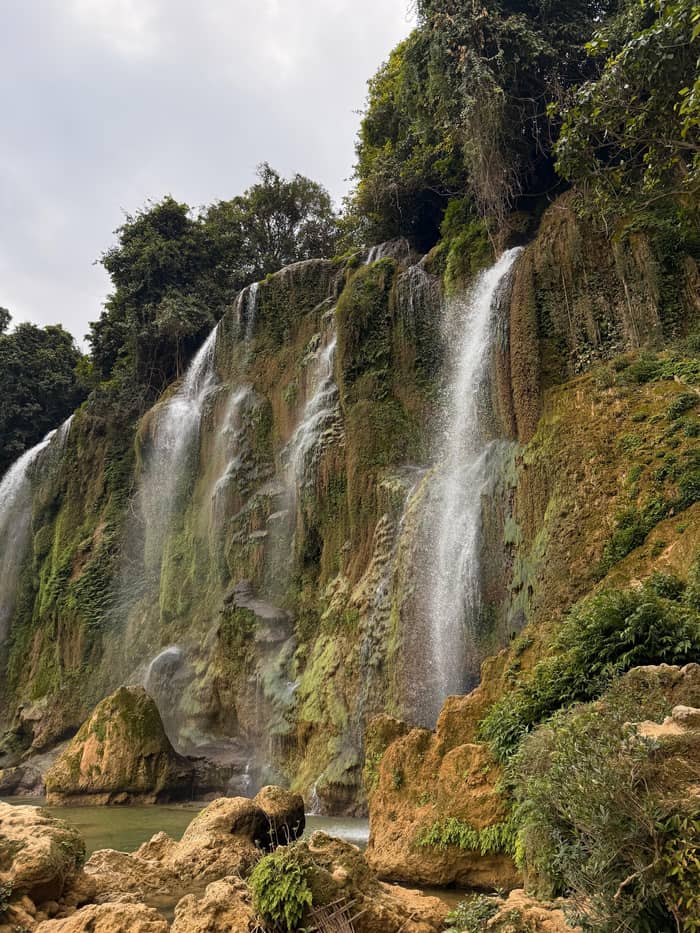
Balanced
September and October
See the 2-day tour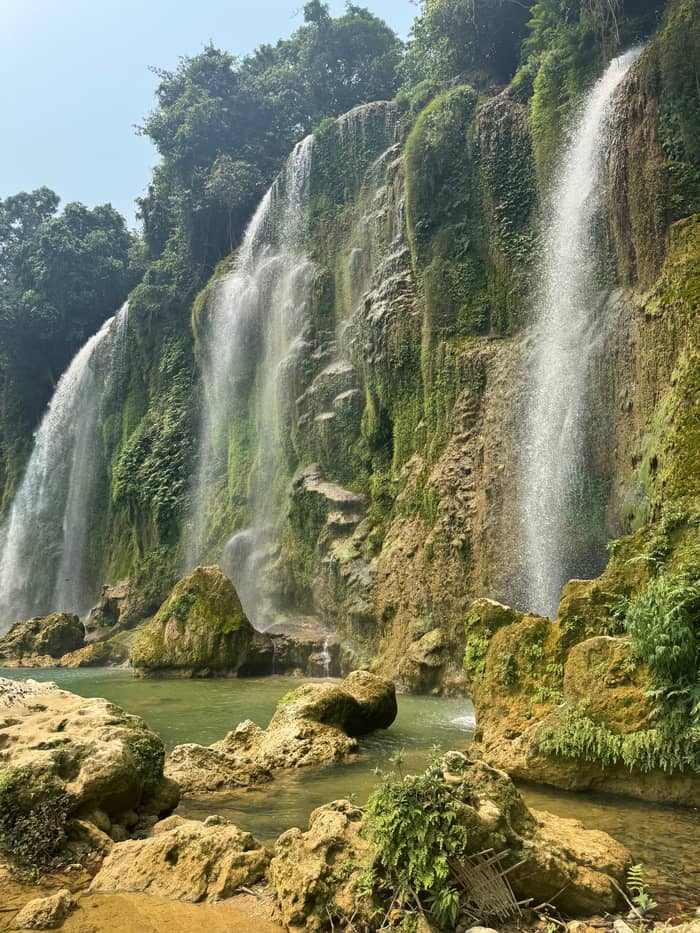
Quietest
November to February
See the 2-day tourBan Gioc waterfall in November is a quieter, clearer version of the place. Rainfall in the Cao Bang record drops to 36 mm in November and 24 mm in December, against 235 mm in July.5,5,5 The Tuoi Tre report counts the period from September to December as the best time to visit, so a November trip is still inside one official window.3 What you give up is volume: Vietnam News Agency notes that in winter the water levels recede.4
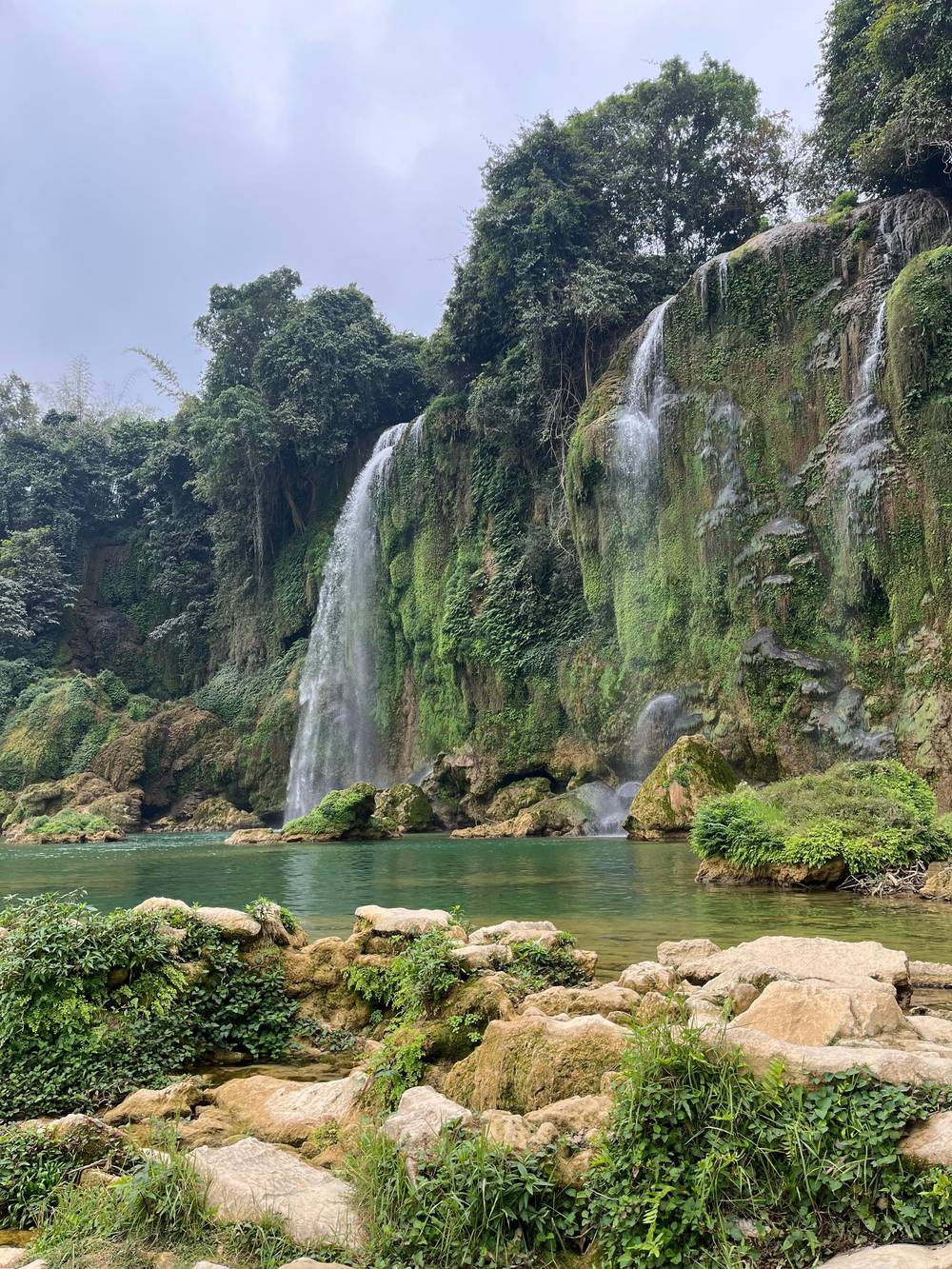
A lower river is not a poor one. The waterfall breaks into more separate streams and the limestone ledges show between them, which suits photographers who want structure rather than a single white sheet. Vietnam Pictorial adds that the rainy season ends in October, which leaves the roads and the cave drier for walking.10 The same dryness helps the viewpoint at Angel Eye mountain, which the agency says visitors choose in September and October because walking is easier.12
If you are choosing between the shoulder months and the heart of winter, remember that the climate record is a long average, not a forecast. Winter days in the far north can be grey, and the low cloud that hangs over the karst is the reason some people prefer the bright, still days of late autumn. The ripening rice in the field beside Khuoi Ky village turns the valley yellow, a colour you may only get in the harvest weeks.13
Compare the dates
Enter your party and compare tours from Hanoi and from Cao Bang city.
Compare 4 side by side
Enter your party and compare tours from Hanoi and from Cao Bang city.
≈
View≈
View≈
View≈
ViewStarting prices as on the booking platform, converted at the ECB reference rate. You see the exact price at booking.
Through the year
December to February
January's 18.4 °C and December's 21.1 °C are the daytime highs, with the lowest rain of the year.5,5,5
March and April
Rain of 68 mm in March and 72 mm in April as the high climbs from 23.2 °C to 28.3 °C.5,5
May to August
Rain between 208 and 255 mm a month, which is when the state press says the falls are most impressive.5,5,2
September and October
Rain falls to 133 mm and then 65 mm, and the festival comes in early October.5,5,6
November
Rain of 36 mm and a daily high of 25.7 °C, inside the September to December window.5,3
The calendar of the place has one fixed event. The yearly Ban Gioc waterfall tourism festival was held from October 5 to 8 in 2023, with a water procession, a photo exhibition, a food fair and a Then singing performance by the local Tay people.6,14 The province also waived tickets for visitors on October 5 to 7 that year.7 If you like crowds and music, plan around those early-October days; if you want the platform to yourself, avoid them.
Vietnam News Agency says summer is the peak season, when the site draws a large number of visitors each year.11 Visitor numbers were high that year: nearly 227,000 people arrived by September 2023, counting the first nine months.15 A summer trip therefore combines the fullest river with the busiest ticket line, and a weekday in September or October often gives the same water with more elbow room. The festival guide on this site lays out the programme if you are weighing those days.
Crowds matter for the cave and the raft as much as for the viewpoint. Our own 2-day tour sends guests into Nguom Ngao early on the second day, before the busiest hours, then goes up to the temple above the falls and arrives at the water afterwards. That order is useful in any month, but it earns its keep on a festival or holiday weekend, when the late morning is the crowded part of the day.
Video
Asia Pioneer Travel on YouTube · Tap play to load the video; not before.
Ban Gioc waterfall is most beautiful between June and October, especially in September and October when it is full of water.
Pack by season
Our own tour is a 2-day trip from Hanoi with a night in a local homestay: about 6 hours on the first day to reach Cao Bang city, then the cave, the temple and the falls on the second day. That shape works in any season, but the weather changes what you notice. In the wet months the second morning is more likely to start in mist and the raft ride is wetter; in autumn it is more likely to start in clear air and the valley is greener.
Use cancellation as part of the plan. You can cancel without a fee until the day before departure, and the price is from $189 per person. Watch the forecast for Cao Bang and Trung Khanh a few days ahead, and book once the week looks settled. If you travel in the rainy months, keep the second day flexible, because a storm on the road can slow the long drive back.
For a longer or shorter visit the same timing rules apply to the other options. A small-group 2-day tour keeps the same 2-day pace from $181, while a full day that starts in Cao Bang city costs from $62 and spends about 40 minutes inside the cave. Whatever you choose, the best months are the ones when you can still say yes to a clear morning on the day, so keep your dates loose where you can.
FAQ
The record gives a daily high of 33.6 °C, 235 mm of rain and 13 wet days for July.5
The Cao Bang record shows 22 mm of rain in February, the lowest figure of the year.5
Yes, a full refund is given if you cancel at least a day before departure.
Sources
Planning the road to Ban Gioc from Hanoi? Ask a real person here.